
Foxnut - THE PROCESS
POST-HARVEST OF MAKHANA
In general, Post-harvest technology involves sun drying, size grading, pre-heating, popping, polishing, grading, and packaging are explained below.
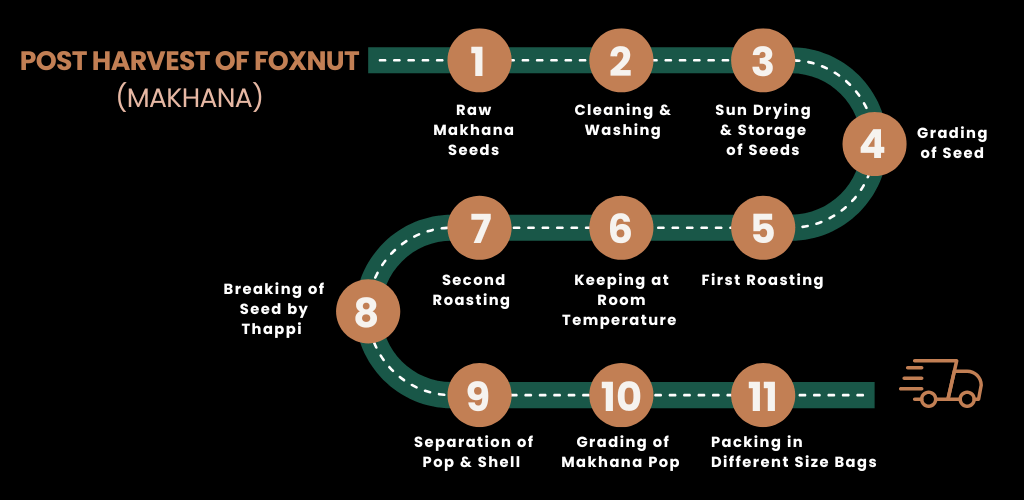
Cleaning & Washing
The matured fresh Makhana seed are first cleaned and removal of several foreign materials other than seed and then washed to remove the dirt and mud.
Sun drying and Storage of seeds
The cleaned makhana seeds are then sun-dried on a mat or cemented floor for 2-3 hours under bright sun light to reduce the moisture to around 31% for temporary storage and transportation.
Storage of Makhana seeds are kept under ambient conditions. Generally, seeds are stored for 20-25 days before processing. At regular intervals, sprinkles of water during storage are done to keep them fresh and maintain the seed quality.
Size grading
The sun-dried seeds are then categorized into 5 to 7 grades according to their sizes through a set of sieves. Grading of Makhana seed facilitates uniform heating of each nut during roasting and it increases the efficiency of processing.
Pre-heating
The sun-dried nuts are generally heated in the earthen pitcher or cast iron pan by placing them over the fire and stirring them continuously. The surface temperature of the pan varies from 250° C – 3000° C and the required time is nearly 5 to 6 minutes at the full capacity of the pan. After preheating of nut, moisture content reduces to approximately 20 percent.
Tempering
The storage of pre-heated seeds for a duration of 48-72 hrs at ambient
conditions is known as the tempering of the seeds. Tempering of seeds is done purposefully to loosen the kernels with a hard seed coat.
Roasting and popping
It is the most important but laborious and painful operation of Makhana processing. About 300 gm of pre-heated and tempered nuts are taken and roasted in a cast iron pan in a single layer over the fire at 2900° C to 3400° C surface temperatures with continuous stirring. After about 1.5 to 2.2 min, a cracking sound is heard from the seed being roasted. The roasted seeds five to seven are scooped quickly by hand and kept on a hard surface and sudden impact force is applied on them by means of a wooden hammer. As the hard shell breaks, the kernel pops out in expanded form, which is called Makhana pop or lawa. Depending upon the quality of raw material, the yield of Makhana varies from 35-40% on a raw seed weight basis.
Polishing
It is done by rubbing the action of Makhana pops among themselves in bamboo baskets. Polishing facilitates more whiteness and luster to the Makhana.
Grading
The popped Makhana lawa is generally graded into three grades at the producer level- lawa and thurri. The lawa is swollen and white with reddish spots whereas, thurri is semi-popped, hard, and reddish in colour.
Packaging
Ordinary gunny bags for local markets and gunny bags with polythene lining are used for distant markets to pack popped Makhana. One bag having a capacity of one quintal of sugar may contain 8 to 9 kg of good quality of Makhana.


